
Connectivity
RV Internet for Monitoring: WiFi vs. Cellular vs. Starlink (Your Alerts Are Only as Good as Their Connection)
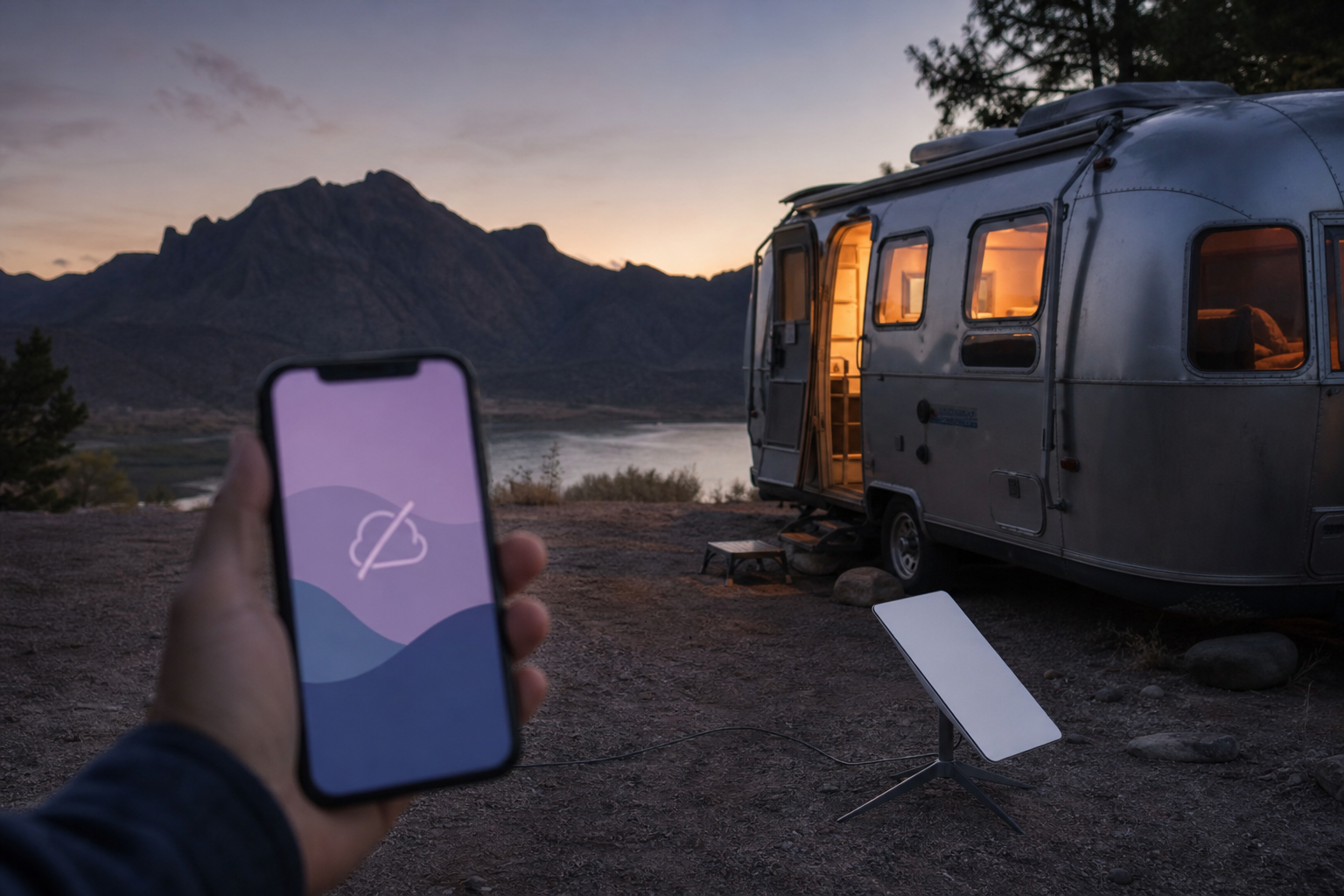
There are hundreds of "Starlink for RV" reviews on the internet. They'll tell you the download speeds, whether you can stream Netflix in a national forest, and how the Mini compares to the Standard dish for #vanlife video calls. This is not one of those reviews.
This is about the question none of them ask: when you're forty minutes away at dinner and your RV's temperature starts climbing, what connection does that alert escape on?
Because here's the pattern we found doing the forum research for our RV monitoring system comparison: the single most common failure across every monitoring product — WiFi models, cellular models, all of them — wasn't the sensor. Sensors are boring, mature technology. It was the connection. The Temp Stick that became a paperweight the first time its owner boondocked. The older Verizon-only Waggle that sat offline for a whole season because the storage lot was in a Verizon dead zone. The alert that didn't arrive because campground WiFi rebooted at 2 a.m. and never came back.
A monitoring system is a chain: sensor → connection → cloud → your phone. RVers obsess over the sensor and the app, and the chain almost always breaks at link two. So let's take the three ways an RV gets internet — WiFi, cellular, and Starlink — and evaluate each one the way a monitoring system would: not "how fast is it?" but "is it there at 2 a.m. when nobody's home?"
The three architectures, through the monitoring lens
An alert is a few hundred bytes. Any of these connections can carry it a thousand times over. Speed is irrelevant here — what matters is availability (is the connection up when the RV is unattended?), power (does it survive an outage or a rig that's shut down?), and coverage (does it work where the RV actually sits, including the storage lot?).
That reframing changes the rankings completely.
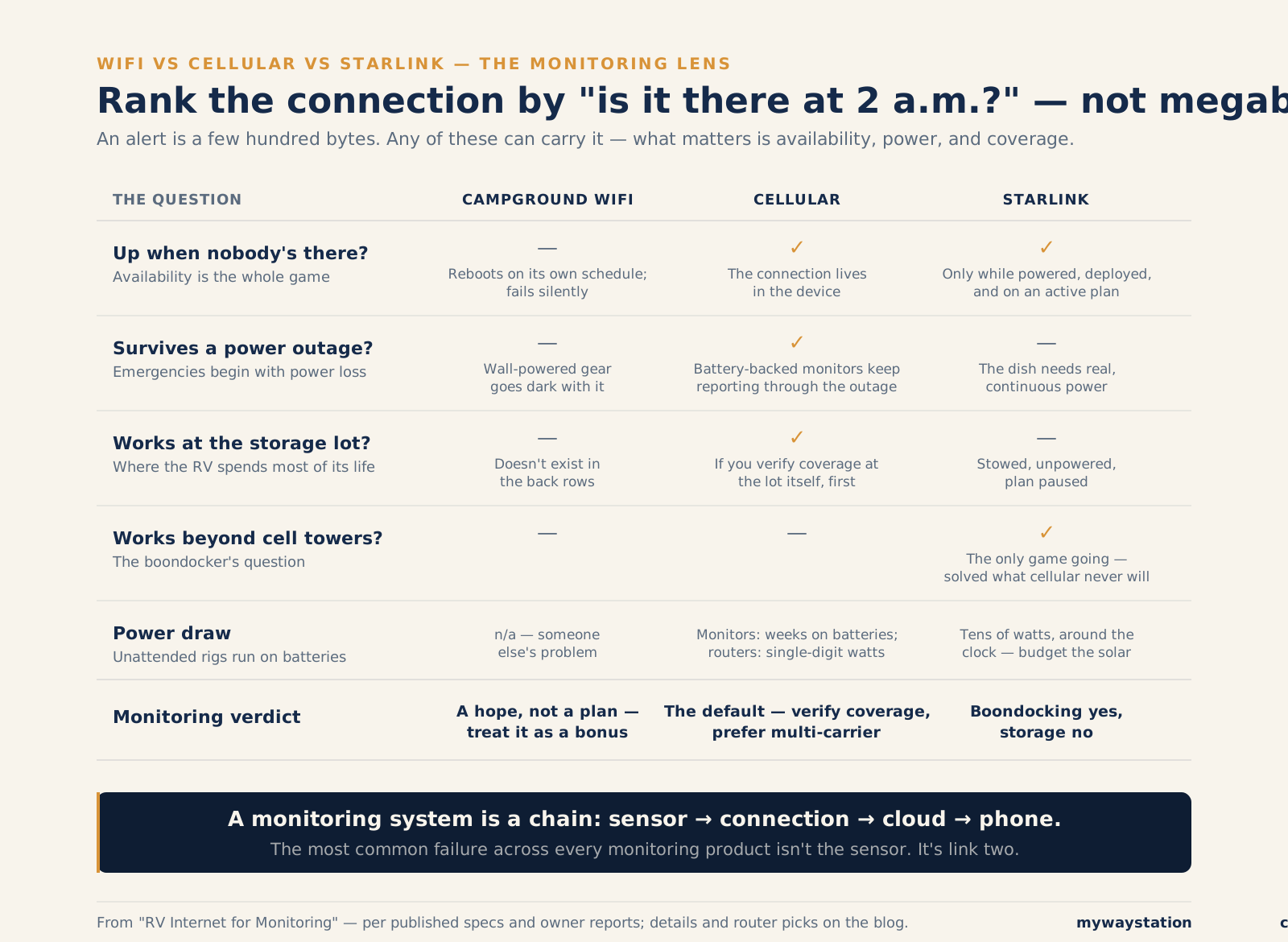
The three architectures, scored on the only questions that matter when nobody's home: availability, power, and coverage.
Campground WiFi: the connection you don't control
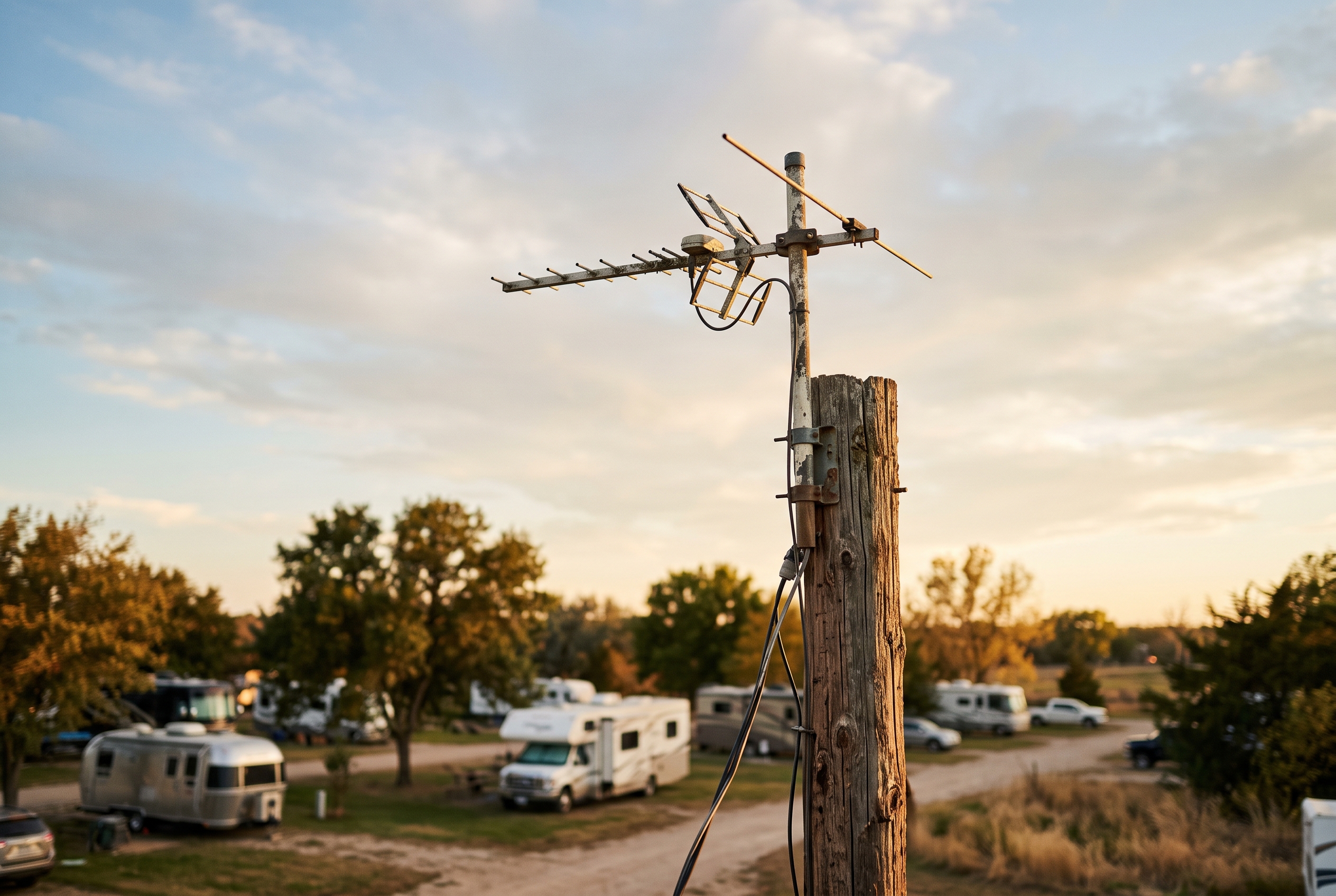
Your pet-safety alert, riding on this.
Campground WiFi is the connectivity option everyone has used and nobody defends. It's oversubscribed on summer weekends, the access points reboot on their own schedule, the signal at site 47 is a rumor, and captive portals — those "click to accept the terms" login pages — silently defeat many monitoring devices, which can connect to the network but can't click "I agree." The community's assessment is settled enough that when pet monitors come up on r/RVLiving, veterans like u/boiseshan flatly warn against trusting park WiFi with anything that matters — its unreliability is infamous, and pets are the worst possible thing to bet on it.
For browsing, that's an annoyance. For monitoring, it's disqualifying, because of a nasty asymmetry: a monitoring system on someone else's WiFi fails silently. When the park's router hiccups, your temperature sensor doesn't send a distress flare — it just stops reporting. Whether you find out depends entirely on whether your platform sends an aggressive "device offline" notification, and how quickly. Some do. Many are gentle about it, on the theory that nagging users about brief dropouts is bad UX. In the pet-in-the-rig scenario, gentle is not what you want.
WiFi-dependent monitors — the Temp Sticks and RV Whisper hubs of the world — aren't badly designed. They're designed for a building. Buildings have routers that stay put, on power that stays on, managed by the person who owns the sensor. An RV has none of those properties unless you bring the router yourself, which brings us to cellular.
Monitoring verdict: acceptable only for a rig parked long-term somewhere with WiFi you personally control — your driveway, your own storage building. Campground WiFi as an alert path is a hope, not a plan.
Cellular: the right architecture, with a carrier-shaped catch
Cellular is the architecture that actually matches the problem. The connection lives in the device, works wherever there's a tower, doesn't care about captive portals, and — critically for monitoring — keeps working on battery when shore power dies, which is precisely the moment most RV emergencies begin. It's why every dedicated remote monitor worth considering (Waggle, MarCELL, Necto) is a cellular temperature monitor at heart, and why the subscription you're grumbling about is mostly a cell plan in a trench coat.
But cellular has one failure mode that dominates owner complaints, and it deserves to be named plainly: single-carrier lock-in.
Most cellular monitors are built around one carrier's network, chosen by the manufacturer, not you. Waggle's older units rode Verizon exclusively — and if your favorite campground, or worse, your storage lot, sat in a weak-Verizon pocket, the device dropped offline and stayed offline. Owners in this situation report cycling through replacement units before realizing the problem was never the device; it was the tower. No firmware update fixes geography. The market has been learning the lesson: Waggle's current monitors carry a multi-carrier SIM that auto-switches between AT&T, Verizon, and T-Mobile — a tacit admission of how much pain single-carrier lock-in caused — while MarCELL's answer is selling separate Verizon and AT&T versions, which helps if you correctly predict, at checkout, where your RV will spend the next five years.
The fix RVers have converged on is to stop letting the monitor choose the carrier: run a cellular router in the rig (specific models below) and let your monitoring gear ride its WiFi. A dual-SIM router can hold two carriers and fail over between them; you can swap SIMs as coverage or pricing changes; and one data plan feeds the monitor, the cameras, and your laptop. The tradeoff is that you've now inherited a small IT department — the router needs power, and you need to know what happens to it during an outage (more on that in the decision framework).
One non-negotiable homework assignment either way: check the carrier's coverage map for where the RV actually sits — the storage lot's street address, your three favorite campgrounds — before buying anything. Not the marketing map with the confident solid colors; look for user-reported coverage (crowdsourced maps like coverage checkers on RV internet forums) if you can. The number-one cellular monitoring complaint is entirely avoidable with ten minutes of map-checking, and almost nobody does it.
Monitoring verdict: the default choice. Prefer multi-carrier flexibility — a dual-SIM router, or at minimum a monitor whose carrier verifiably covers where the RV parks and sleeps.
Starlink: brilliant while camping, blind in storage
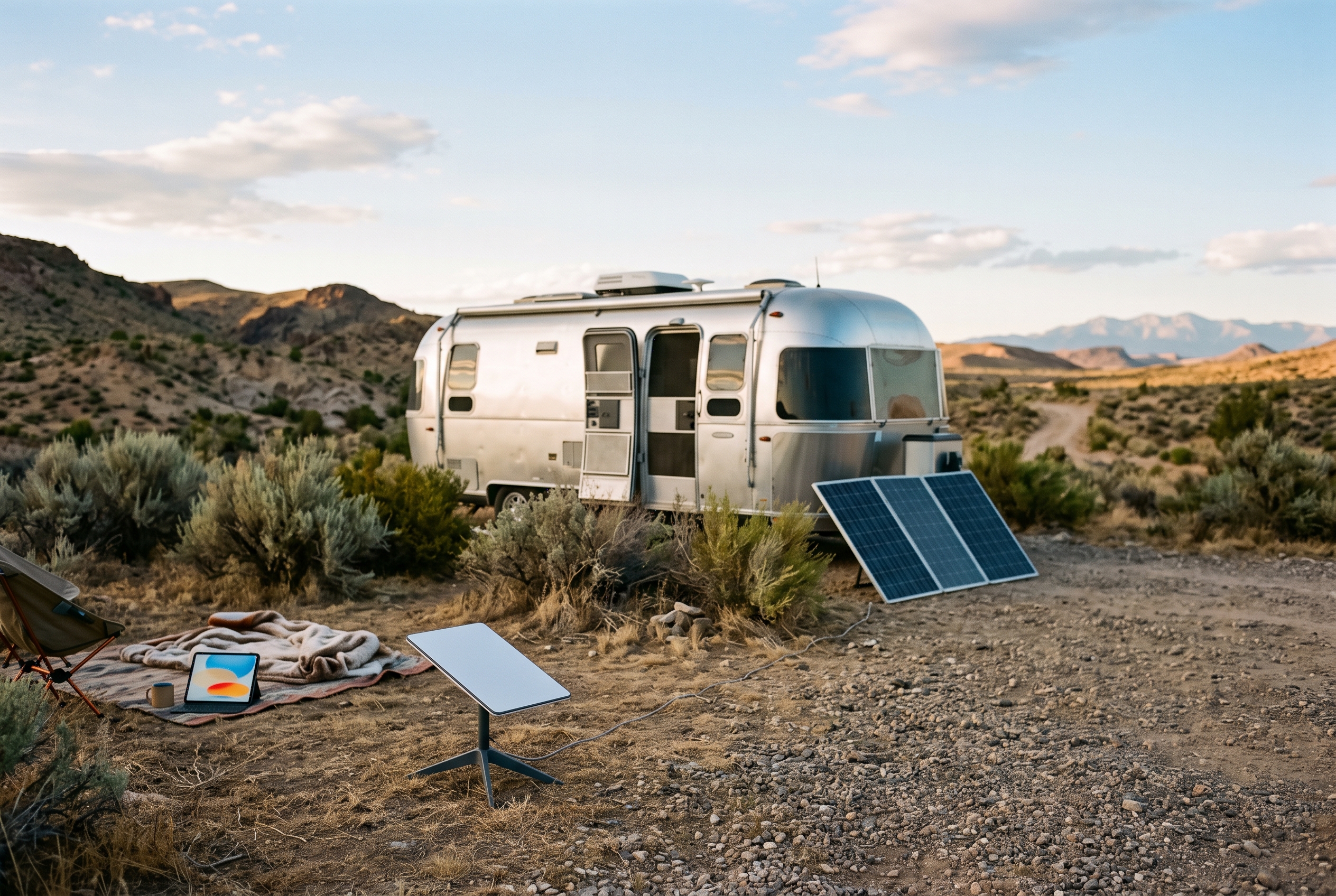
Starlink genuinely solved a problem cellular never will: connectivity where there are no towers at all. For boondockers beyond cell range, it's not one option among several — it's the only game going, and as a while-you're-camping alert path it's excellent. Your Home Assistant setup, your cameras, your sensors all ride it happily; an alert needs a fraction of a percent of its capacity.
The current Roam lineup as of mid-2026: Roam 100GB at $55/month and Roam Unlimited at $175/month, with a 300GB middle tier at $80/month, no contract, pause-and-resume billing. VERIFY at publish: Roam tier pricing Monitoring traffic is a rounding error against even the smallest cap, so the cheap tier is plenty if monitoring is the goal.
For monitoring, though, Starlink has two structural problems the streaming-focused reviews never mention:
1. Power draw. A Starlink dish is a phased-array antenna having an ongoing conversation with space, and it eats accordingly. The Standard dish averages 75–100W by Starlink's own spec sheet — before you count the snow-melt heater, which the spec rates for melting up to 40mm of snow an hour and which only pushes the number up. The Starlink Mini is the monitoring-friendly one: Starlink's spec sheet says 25–40W average, and independent measurements put light-duty draw around 20–25W, idling as low as 12–15W — with no snow-melt heater to spike. Even so, run the math for an unattended rig: a Mini averaging ~30W is roughly 720Wh per day — call it 60Ah a day from a 12V battery bank. A modest bank without solar is dead in a couple of days. Compare that to a dedicated cellular monitor sipping from AA batteries for weeks, or a cellular router at 5–10W, and you see why "just leave the Starlink on" is not a monitoring plan unless you have serious solar.
2. The storage problem. Starlink only works while it's powered, aimed at the sky, and on an active plan. A rig in storage typically has none of those: systems shut down, dish stowed, and service paused to stop the monthly bill. Starlink's pause option is now Standby Mode — $10/month (doubled from $5 in early 2026), which keeps the service alive at ~500 kbps. VERIFY at publish: Standby Mode fee and speed Here's the wrinkle almost nobody has noticed: 500 kbps is a miserable speed for Netflix and a luxurious speed for monitoring — hundreds of times more than alerts need. So a stored RV with a Mini left powered, sky view, and Standby Mode active could, in principle, keep its monitoring alive for $10/month. In practice that requires storage with a sky view (not a covered lot), a maintained power source, and a dish you're willing to leave deployed. For most stored rigs, Starlink is simply off — and so is every alert that depended on it.
Monitoring verdict: the best (often only) alert path while boondocking beyond cell coverage — budget the watts, strongly prefer the Mini. Nearly useless for a rig in storage, which is where your RV spends most of its life.
The routers RVers actually use
If you're building connectivity for monitoring rather than buying a self-contained cellular monitor, these are the names that come up constantly in RV internet circles:
- Peplink MAX BR1 Pro 5G — the full-timer's choice and the one the RV internet nerds treat as the reference standard. 5G modem (the current hardware revision, shipping since late 2025, runs Qualcomm's X65 silicon), WiFi 6, runs on 12V DC natively (10–30V input with ignition sensing), rated for -40°F to +149°F — which matters in a vehicle that is sometimes a freezer and sometimes an oven — and its WiFi-as-WAN feature can blend campground WiFi with cellular and fail over automatically. Expensive, and Peplink's PrimeCare subscription (sold as 1-, 2-, or 4-year add-on plans) adds ongoing cost, but this is the "the connection is infrastructure" option.
- GL.iNet Spitz AX (GL-X3000) — the value pick: dual-SIM with failover between two carriers, WiFi 6, runs OpenWrt so tinkerers can script it, at a fraction of Peplink money. The dual-SIM failover is the headline for monitoring — it's the direct antidote to single-carrier lock-in.
- GL.iNet Puli AX (GL-XE3000) — the Spitz's sibling with a trick highly relevant here: a built-in 47.4Wh (6,400mAh) battery. When shore power drops, the router keeps running for hours — which means the power-loss alert from your monitoring system actually has a live connection to escape on. That's the exact failure chain (power dies → router dies → alert dies) that strands wall-powered setups, solved in hardware.
Pair any of these with a data plan on the carrier that actually covers your ground, and every WiFi-dependent device in the rig — including monitors that would otherwise be storage-lot paperweights — becomes effectively cellular. The router-as-backbone approach also solves a gap owners keep hitting: a lot of good RV gear (Victron battery monitors, Bluetooth tank senders) speaks only Bluetooth, readable from the couch and invisible from forty miles away — there's an entire iRV2 thread, "Remotely Monitoring Bluetooth-Only RV Devices: Solutions and Limitations", of owners wrestling with exactly this. A small always-on gateway riding the router's connection bridges that gap, and it's the backbone of the DIY Home Assistant monitoring build, where the router is as load-bearing as the sensors.
Which connectivity for which RVer

Four RVers, one rule: plan the stack for the rig's loneliest month, not its best one.
The weekender (rig used monthly, stored between trips). Your monitoring problem is 90% a storage problem — the RV is alone 25+ days a month. Starlink is the wrong tool; a self-contained cellular monitor with battery backup, on a carrier you've verified at the storage lot, is the whole answer. Skip the router unless you want one for trips anyway.
The full-timer. The rig is your house; treat internet as infrastructure. A dual-SIM cellular router (Peplink or Spitz AX class) as the backbone, Starlink as the boondocking layer, and your monitoring rides both with failover. You're the one user class where "RV internet" and "monitoring internet" are the same build.
The boondocker. Starlink Mini for the sky, sized into your battery budget (~720Wh/day if left on around the clock, using ~30W of Starlink's official 25–40W average range). But note the honest subtlety: while you're at the rig boondocking, remote monitoring matters less — you're the monitor. The dangerous window is day trips away from a rig running on battery, where the trailhead often has cell service the campsite doesn't. A cellular monitor as a second, low-power path is cheap redundancy.
The stored rig. The hardest case and the one every connectivity option quietly fails — campground WiFi doesn't exist there, Starlink is powered down, and even cellular monitors die when their battery backup runs out days into a months-long sit. This deserves its own article, and it has one: monitoring an RV in storage. The short version: verified cellular coverage at the lot, a monitor with months-long battery life or a maintained power source, and an offline alert you'll actually notice.
The blind spot nobody prices in
Notice the pattern across all three architectures: connectivity is strongest exactly when you need monitoring least. While you're camping — present, awake, twenty feet from the dog — you have Starlink, cellular, maybe even functional park WiFi. When the rig sits alone in a storage lot for five months — the period when pipes freeze, batteries die, mold blooms, and nobody would notice for weeks — that's when the dish is stowed, the plan is paused, and the router is dark.
Every dollar RVers spend on connectivity flows toward the camping scenario, because that's when internet is fun. Monitoring needs are the inverse. If you take one thing from this article, make it this: plan your rig's connectivity for its loneliest month, not its best one.
FAQ
Does Starlink work for RV monitoring? While the RV is in use and the dish is powered — yes, very well; alerts need trivial bandwidth. The catches are power draw (a 25–40W official average for the Mini, 75–100W for the Standard dish) and storage: a stowed, unpowered, or paused Starlink carries zero alerts. Starlink is a while-camping alert path, not an always-there one.
How much does Starlink Roam cost for an RV? As of mid-2026: Roam 100GB at $55/month, Roam Unlimited at $175/month, with a 300GB middle tier at $80/month, no contract. The Standby Mode pause option is $10/month at ~500 kbps — slow for streaming, ample for monitoring. VERIFY at publish: Standby price
Do RV temperature monitors work without WiFi? Cellular ones do — that's their entire reason for existing, and why they carry a subscription (the subscription is the cell plan). WiFi-only monitors like Temp Stick need internet already present where the RV sits. Our full comparison sorts the market by exactly this distinction.
What's the best internet setup for a full-time RVer? The consensus stack in RV internet communities: a dual-SIM cellular router (Peplink MAX BR1 Pro 5G if budget allows, GL.iNet Spitz AX for value) with plans on two carriers, plus Starlink for beyond-coverage camping. For monitoring specifically, prefer a router with battery backup — or on a battery-protected circuit — so a power outage doesn't take down the very connection your power-loss alert needs. (Why power-loss alerts matter more than temperature alerts is a whole separate story.)
Can I check on my RV in storage with Starlink? Usually not. It requires leaving the dish deployed with a sky view, keeping it powered (a real battery/solar commitment at a realistic 15–25W continuous for a lightly-loaded Mini), and paying $10/month Standby or a full plan. A few driveway-stored rigs can pull it off; most storage lots can't. Cellular — with coverage verified at the lot itself — is the realistic storage answer.
Is campground WiFi good enough for a pet monitor? Treat it as a bonus, never as the plan. It fails silently, without warning, on someone else's schedule, and the monitor can't always tell you it's gone dark. For anything with a heartbeat in the rig, use a connection that lives in the RV — cellular monitor or your own router.
Bottom line
Speed reviews rank RV internet options by megabits. Ranked by will the alert get out — the only metric that matters when something's alive or expensive inside the rig and you're not there — the order is: cellular you've coverage-checked first, Starlink (Mini, with a power budget) for beyond-coverage camping, campground WiFi never. And for the storage months, when the RV is most alone and every convenient connection is powered down: that's not an afterthought, that's the design constraint. Start there and work backward.
[Disclosure placeholder: once Waystation launches, add standard competitor-disclosure line per the comparison article.]
Stay in the loop
Occasional updates from the road and the workbench — what we're learning, what we're building. No spam, easy out.
Draft preview — this form connects to the email service at launch.